AI Usage Tracking: The Complete Guide to Monitoring AI Costs, Token Usage, and Profitability
AI usage tracking gives businesses complete visibility into token consumption, API costs, and customer profitability, enabling them to optimize AI spending and implement effective usage-based billing. Learn how tracking AI usage across providers like OpenAI, Claude, and Gemini helps organizations reduce costs, improve margins, and scale AI-powered applications with confidence.

John Hurley
CEO / Co Founder
Billing Insight
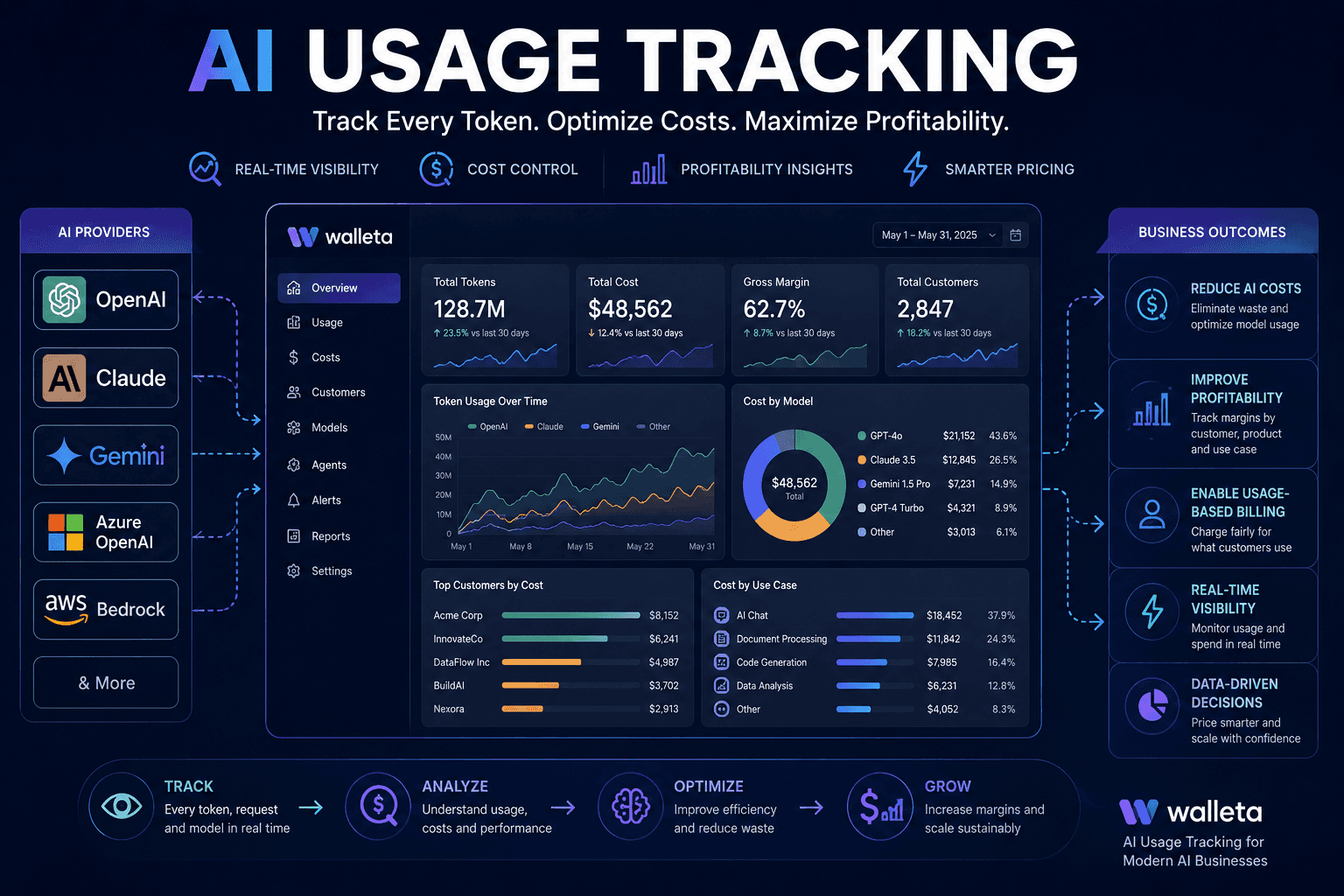
AI Usage Tracking: The Complete Guide to Monitoring AI Costs, Token Usage, and Profitability
Artificial intelligence is transforming how businesses build software, automate workflows, and serve customers. From customer support chatbots to autonomous AI agents, organizations are consuming millions of AI tokens every day. But with this rapid growth comes a new challenge: AI usage tracking.
Without accurate AI usage tracking, companies have little visibility into token consumption, API costs, customer profitability, or the true cost of delivering AI-powered products. As AI becomes a larger percentage of software operating expenses, tracking usage is no longer optional—it's essential.
In this guide, we'll explain what AI usage tracking is, why it matters, and how modern AI companies use it to improve profitability, optimize pricing, and scale with confidence.
What Is AI Usage Tracking?
AI usage tracking is the process of monitoring how artificial intelligence services are consumed across your applications, users, customers, and internal systems.
An effective AI usage tracking platform measures:
AI token usage
API requests
Prompt and completion tokens
AI provider costs
Customer usage
Team usage
AI model performance
AI infrastructure costs
Usage-based billing metrics
Profitability by customer
Whether you're using OpenAI, Anthropic Claude, Google Gemini, Azure OpenAI, AWS Bedrock, or multiple providers simultaneously, AI usage tracking gives you complete visibility into your AI operations.
Why AI Usage Tracking Is Critical
Many AI startups launch products without understanding what each customer actually costs.
A customer paying $99/month may generate $30 in AI costs—or $500.
Without AI usage tracking, businesses cannot answer questions like:
Which customers consume the most AI tokens?
Which AI models are driving costs?
Are we making money on enterprise customers?
Should we charge per token or per API call?
Which prompts are the most expensive?
Which AI agents are inefficient?
What are our AI gross margins?
These questions directly impact profitability.
The Hidden Cost of AI APIs
Most AI providers charge based on token consumption.
Examples include:
OpenAI GPT models
Claude by Anthropic
Google Gemini
Azure OpenAI
Amazon Bedrock
Every API call generates:
Input tokens
Output tokens
Model charges
Request metadata
As applications grow, millions—or even billions—of tokens flow through your systems each month.
Without AI usage tracking, these costs become nearly impossible to manage.
Benefits of AI Usage Tracking
1. Reduce AI Costs
AI usage tracking identifies:
Expensive prompts
Inefficient workflows
Duplicate requests
Overused models
Unnecessary API calls
Companies often discover they can reduce AI costs by 20–40% simply by understanding how AI is being used.
2. Improve AI Profitability
Tracking usage allows organizations to calculate:
Gross margin
Net margin
Cost per customer
Cost per feature
Cost per AI agent
Instead of guessing profitability, companies can make pricing decisions using real financial data.
3. Enable Usage-Based Billing
Many AI companies are moving away from fixed subscriptions toward usage-based billing.
AI usage tracking makes it possible to bill customers based on:
Tokens consumed
AI requests
Credits used
Workflow executions
AI agent activity
Compute usage
Customers only pay for what they use, while providers protect their margins.
4. Monitor AI Spend in Real Time
Real-time dashboards allow teams to monitor:
Daily AI costs
Monthly AI spend
Token consumption
Provider costs
Customer usage
Department spending
Finance teams gain unprecedented visibility into AI operating expenses.
What Should You Track?
An effective AI usage tracking platform should monitor:
AI Models
GPT-5
GPT-4
Claude
Gemini
Llama
Mistral
Custom models
AI Providers
OpenAI
Anthropic
Google
Microsoft Azure
AWS Bedrock
Usage Metrics
Prompt tokens
Completion tokens
Total tokens
API requests
Response time
Latency
Failures
Cost per request
Cost per customer
AI Usage Tracking for SaaS Companies
Modern SaaS businesses increasingly depend on AI to power:
Customer support
Document generation
Sales assistants
Marketing automation
Coding assistants
AI agents
Workflow automation
Tracking usage enables product teams to optimize customer experiences while keeping infrastructure costs under control.
AI Usage Tracking for AI Agents
AI agents are one of the fastest-growing use cases for artificial intelligence.
Each AI agent may perform dozens—or hundreds—of API calls to complete a single task.
Without AI usage tracking, organizations lose visibility into:
Agent efficiency
Cost per task
Token consumption
Workflow profitability
Multi-model orchestration costs
AI Usage Tracking Across Multiple Providers
Many businesses use multiple AI providers simultaneously.
For example:
OpenAI for content generation
Claude for long-context analysis
Gemini for multimodal capabilities
A centralized AI usage tracking platform consolidates costs across every provider into a single dashboard.
AI Usage Tracking and FinOps
AI FinOps is becoming an essential discipline.
Just as cloud FinOps helps organizations optimize AWS and Azure spending, AI usage tracking helps optimize AI infrastructure costs.
Organizations can:
Forecast AI budgets
Allocate costs
Optimize model selection
Improve gross margins
Reduce operational waste
Best Practices for AI Usage Tracking
Successful organizations follow these best practices:
Track every API request.
Monitor token usage by customer.
Capture provider costs automatically.
Build real-time dashboards.
Alert on abnormal AI spending.
Measure profitability by account.
Compare AI models based on cost and performance.
Integrate usage with billing systems.
Review AI spending weekly.
Continuously optimize prompts and workflows.
Why Businesses Need AI Usage Tracking Now
AI costs are becoming one of the largest variable expenses for software companies.
Businesses that lack visibility into usage often struggle with:
Unexpected AI bills
Poor pricing strategies
Negative customer margins
Limited forecasting
Inaccurate budgeting
AI usage tracking transforms raw usage data into actionable business intelligence, helping companies scale sustainably while maintaining healthy margins.
How Walleta Simplifies AI Usage Tracking
Walleta was built specifically for companies developing AI-powered applications.
Instead of manually combining spreadsheets, provider invoices, and billing systems, Walleta provides a centralized platform to:
Track AI usage across multiple providers
Monitor token consumption in real time
Measure AI costs by customer, product, or feature
Analyze profitability and gross margins
Support usage-based and hybrid billing models
Integrate with platforms like Stripe, Make.com, and leading AI providers
Turn complex AI consumption data into clear financial insights
With Walleta, engineering, finance, and product teams gain a shared view of AI usage, making it easier to optimize costs, price products accurately, and grow with confidence.
Final Thoughts
As artificial intelligence becomes the foundation of modern software, AI usage tracking is evolving from a technical metric into a business necessity.
Organizations that understand their AI usage can reduce costs, improve pricing, increase profitability, and deliver better customer experiences. Those that don't risk losing visibility into one of their fastest-growing operating expenses.
Whether you're building AI agents, SaaS applications, APIs, or enterprise automation tools, investing in comprehensive AI usage tracking today will position your business for sustainable growth tomorrow.
If you're looking for a platform that combines AI usage tracking, token analytics, usage-based billing, and AI profitability insights, Walleta helps you understand every token, every customer, and every dollar spent—so you can focus on building great AI products.


