The AI Agency Playbook: 10 Principles for the Future of Agencies
Discover the 10 principles that will define the next generation of AI agencies—from recurring revenue and managed AI services to customer economics, vertical expertise, and thought leadership.

John Hurley
CEO / Co-Founder
Agencies

By John Hurley, Co-Founder of Walleta and Former Co-Owner of Webexcellence
The AI agency industry is being built right now.
And most agencies don't realize it.
We're still in the early stages of what I believe will become one of the biggest transformations in the technology services industry since the birth of the web.
I've seen this movie before.
In my early 20s, I co-owned Webexcellence, which grew into one of the largest web development agencies in Indiana. We lived through the transition from businesses having no website to every business needing one.
At the time, there were thousands of companies trying to figure out what a website was supposed to do for their business.
There were also thousands of agencies trying to figure out how to make money building them.
The agencies that survived didn't simply learn how to build better websites.
They figured out how to build businesses around the technology.
I believe we're at that moment again.
Only this time, the technology isn't the website.
It's AI.
And I think the agencies that win the next decade will follow a very different playbook than the agencies that dominated the last one.
Here are the 10 principles I believe will define the next generation of AI agencies.
1. Stop Selling AI. Start Selling Business Outcomes.
This may be the most important principle of all.
Your customer doesn't want an AI agent.
They don't want GPT-5.
They don't want Claude.
They don't want a sophisticated Make.com workflow.
And they certainly don't want to spend their afternoon learning about tokens.
They want fewer customer-service employees answering repetitive questions.
They want salespeople spending more time closing deals.
They want leads followed up with immediately.
They want invoices processed faster.
They want employees spending less time on repetitive work.
They want more revenue.
They want lower costs.
They want a better business.
The technology is simply how you get there.
The best AI agencies will therefore stop positioning themselves as technology companies and start positioning themselves as business transformation companies.
The question shouldn't be:
"What can we build with AI?"
The question should be:
"Where is this business losing time, money, or opportunity—and how can AI change that?"
That's a fundamentally different sales conversation.
2. The AI Implementation Is the Beginning, Not the Product
Traditional agencies have historically had a problem.
They build something.
They launch it.
They send the invoice.
And then they have to figure out what to sell the customer next.
AI changes this equation.
An AI implementation isn't static.
It evolves.
Models change.
Providers change.
Pricing changes.
Prompts change.
Workflows change.
Data changes.
Customer behavior changes.
New AI capabilities emerge.
And businesses discover new opportunities once they see what AI can actually do.
That means the implementation isn't the end of the engagement.
It's the beginning of an ongoing relationship.
The best AI agencies will understand this very early.
They won't sell:
"We'll build your AI system for $25,000."
They'll sell:
"We'll build, manage, optimize, and continuously improve your AI operation."
That's a much bigger business.
3. AI Agencies Will Become Managed Service Providers
I believe this is where the industry is ultimately heading.
The traditional agency model was project-based.
Build a website.
Build an application.
Launch a campaign.
Complete the project.
The managed-service model is different.
The agency becomes part of the customer's ongoing operation.
That's incredibly powerful when applied to AI.
Imagine an agency managing:
25 AI agents
40 automated workflows
Customer-service automation
Sales automation
Internal knowledge systems
AI-powered reporting
Document processing
Lead qualification
Employee copilots
That isn't a project anymore.
That's infrastructure.
And infrastructure requires ongoing management.
The AI agency of the future may look much more like an MSP than a traditional development agency.
4. Recurring Revenue Will Become the Economic Foundation
This is where I think AI agencies have an enormous opportunity.
The traditional agency model often creates unpredictable revenue.
One month you're closing $100,000 in projects.
The next month you're trying to figure out where the next $100,000 is coming from.
AI creates the opportunity to build something much more valuable:
Recurring relationships.
An agency could charge a customer a monthly fee for:
AI management
Workflow management
Agent management
Optimization
Monitoring
Reporting
Strategy
Support
New automations
Continuous improvement
The customer isn't paying for AI.
They're paying for the agency to continuously create value from AI.
That's an important distinction.
And it creates a much more predictable business.
5. Don't Make Your Agency the Bank
There's another lesson I think AI agencies need to learn early.
Don't blindly absorb your customer's AI consumption costs.
Imagine an agency charges $3,000 per month to manage a customer's AI infrastructure.
The customer suddenly doubles its AI usage.
Then triples it.
Then launches a new workflow that generates millions of API calls.
If the agency owns all of the underlying AI consumption, the agency's gross margin can disappear overnight.
That's not a business model.
That's a liability.
A cleaner model is for the customer to maintain ownership of its AI provider accounts whenever possible.
The customer pays its AI providers for actual consumption.
The agency charges for the expertise, infrastructure, management, optimization, and ongoing service surrounding that consumption.
This creates a critical separation:
The customer's AI usage can be variable while the agency's service revenue remains predictable.
That's one of the ideas that led us to build Walleta.
6. Every AI Agency Needs to Understand Its Customers' Economics
Here's something I think will separate the great AI agencies from the average ones.
They'll understand economics.
Not just technology.
If you have 50 customers paying you $2,500 per month, you have $125,000 in monthly recurring revenue.
That's great.
But what does it cost you to support those customers?
Which customers are using the most AI?
Which workflows are expensive?
Which customers are becoming more complex?
Which customers are consuming significantly more resources than they were six months ago?
Which implementations are highly profitable?
Which aren't?
Which customers are growing?
And perhaps most importantly:
Where should you invest your team's time?
AI agencies will need visibility into these questions.
Because the agency business is ultimately still a business.
Revenue matters.
Costs matter.
Margins matter.
Customer lifetime value matters.
And as AI becomes more deeply embedded in customer operations, understanding those economics becomes increasingly important.
7. The Best AI Agencies Will Own the Customer's "AI Layer"
This is where I think the biggest strategic opportunity exists.
An agency shouldn't simply build one AI workflow.
It should become the company that understands how that customer's business uses AI.
Think about that for a moment.
The agency knows:
Which AI systems the company uses
Which workflows are automated
Which agents exist
Which models power them
Where AI is creating value
Where AI is creating costs
Where additional automation makes sense
What should be optimized
What should be replaced
The agency becomes the connective tissue between the business and its AI infrastructure.
That's an incredibly valuable position.
And once an agency reaches that position, switching providers becomes much harder.
Not because the agency has locked the customer in.
Because the agency has become genuinely useful.
8. AI Agencies Should Build a Vertical, Not Just a Capability
I would strongly encourage AI agency owners to think about specialization.
Don't just be:
"An AI agency."
Be:
"The AI agency for mortgage companies."
Or:
"The AI agency for law firms."
Or:
"The AI agency for manufacturers."
Or:
"The AI agency for healthcare organizations."
Or:
"The AI agency for home-service businesses."
Why?
Because vertical expertise compounds.
You learn the workflows.
You learn the terminology.
You learn the economics.
You learn the regulations.
You learn the common pain points.
You build reusable systems.
And eventually, you aren't selling an experiment.
You're selling a proven solution.
That's how agencies scale.
9. The Agency's Greatest Asset Will Be Its Knowledge
There's another major shift happening that I don't think gets enough attention.
AI is making technical implementation easier.
That means the technical advantage of an agency will eventually become less defensible.
If everyone can build an AI workflow, building an AI workflow isn't enough.
The competitive advantage becomes:
Knowing what to build.
Knowing which problems matter.
Knowing which workflows are worth automating.
Knowing what customers will pay for.
Knowing how to integrate AI into a particular industry.
Knowing what creates measurable ROI.
Knowing how to manage the system after it launches.
The best agencies will turn their experience into intellectual property.
They'll build frameworks.
Templates.
Playbooks.
Industry-specific workflows.
Benchmarks.
Data.
Processes.
And proprietary methodologies.
The agency that knows more about a customer's industry than its competitors will have a massive advantage.
10. Thought Leadership Will Become a Competitive Advantage
This may be the most overlooked opportunity of all.
The AI agency market is crowded.
Thousands of agencies are entering it.
Everyone is saying:
"We build AI agents."
Everyone is saying:
"We automate your business."
Everyone is saying:
"We help companies leverage AI."
That's not differentiation.
The agencies that stand out will teach the market.
They'll publish their thinking.
They'll develop frameworks.
They'll explain what is changing.
They'll publish benchmarks.
They'll share what works.
They'll challenge conventional wisdom.
They'll create terminology.
And eventually, people will start associating their company with the category itself.
That's how thought leadership works.
You don't become a thought leader by announcing that you're one.
You become one by consistently having ideas worth listening to.
The AI Agency Opportunity Is Bigger Than Most People Realize
When I look back at the early days of Webexcellence, I remember how much uncertainty existed around the internet.
Businesses knew something important was happening.
They just didn't know what to do about it.
The agencies that helped them figure it out became incredibly valuable.
I think we're experiencing that same moment again.
Except this time, businesses aren't asking:
"Do we need a website?"
They're asking:
"What should AI actually be doing inside our business?"
That's a much bigger question.
And it's going to create a massive opportunity for agencies.
But the agencies that win won't necessarily be the ones with the most sophisticated technology.
They'll be the ones that understand business.
They'll understand recurring revenue.
They'll understand customer economics.
They'll understand their customer's industry.
They'll understand AI infrastructure.
And they'll understand how to turn an implementation into an ongoing relationship.
The New Agency Flywheel
I think the winning model looks something like this:
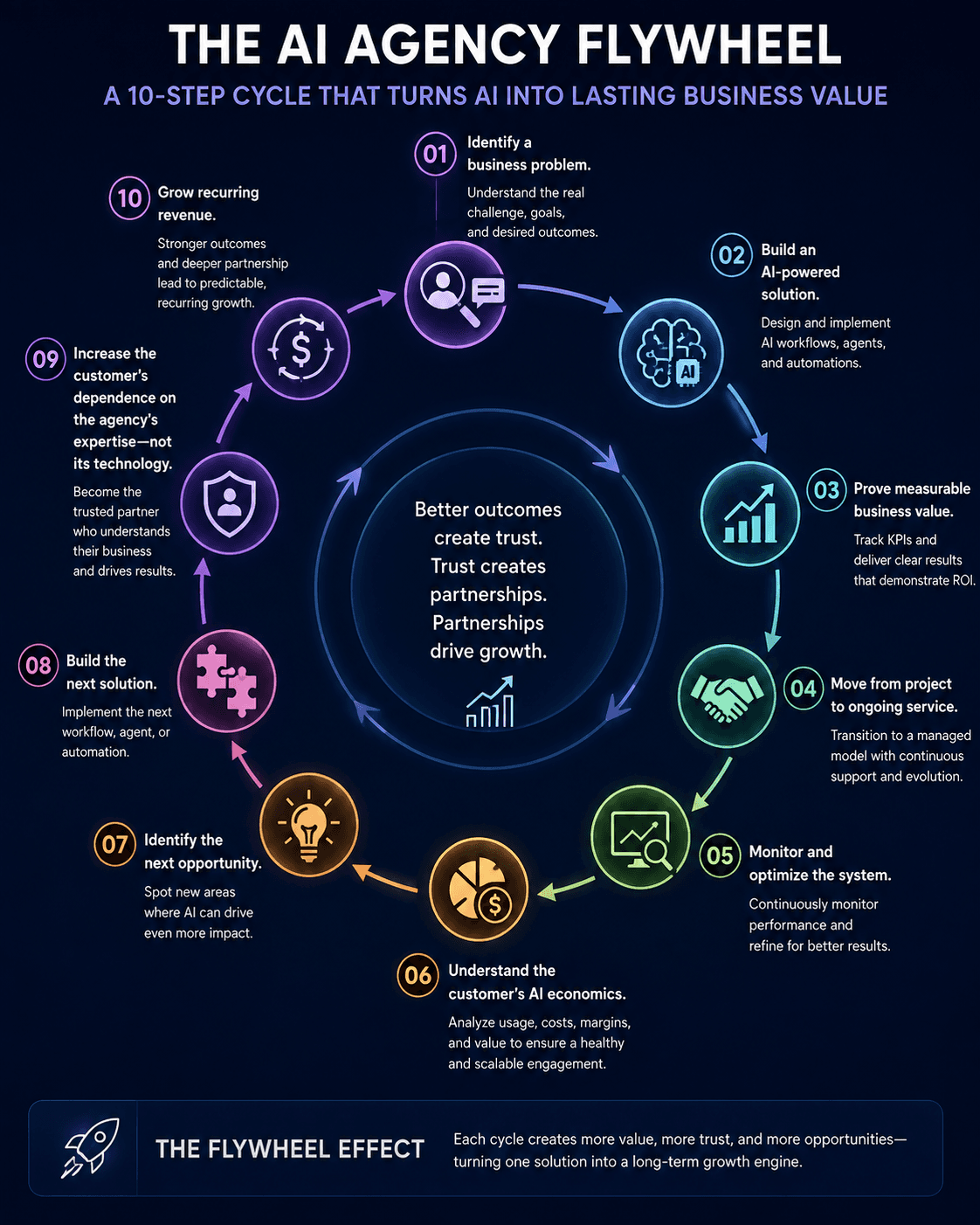
That's the flywheel.
And once it starts working, the agency stops chasing projects.
It starts building an installed base.
That's a fundamentally different business.
From Web Agencies to AI Agencies
The technology may be different.
But the fundamental agency lesson hasn't changed in 25 years.
The best agencies don't simply build things.
They become trusted partners.
They understand their customers.
They solve problems.
They create measurable value.
They stay involved.
And they find ways to make that relationship more valuable over time.
The difference today is that AI gives agencies an opportunity to become much more deeply embedded in the customer's business.
We're moving from:
Websites → Applications → SaaS → AI Workflows → AI Agents → Autonomous Business Systems
The agency is evolving with it.
And I believe we're still very early.
The biggest AI agencies of the next decade probably haven't been built yet.
Many of them are being started right now by people who may not even think of themselves as agency owners.
They're developers.
They're automation experts.
They're consultants.
They're entrepreneurs.
They're freelancers.
They're operators.
And they're discovering that the real opportunity isn't simply building AI.
It's building a business around helping companies operate with AI.
That's the opportunity.
And that's why I believe the next generation of great agencies won't just implement AI.
They'll manage it, optimize it, measure it, and continuously turn it into business value.
The technology will keep changing.
The agencies that understand the business model will win.
Build it. Manage it. Measure it. Improve it.


